 Formula 1
Verstappen Laughed Out Loud in Simulator After Silverstone’s 2026 Energy Management Demands Became Clear
Formula 1 · Jun 29

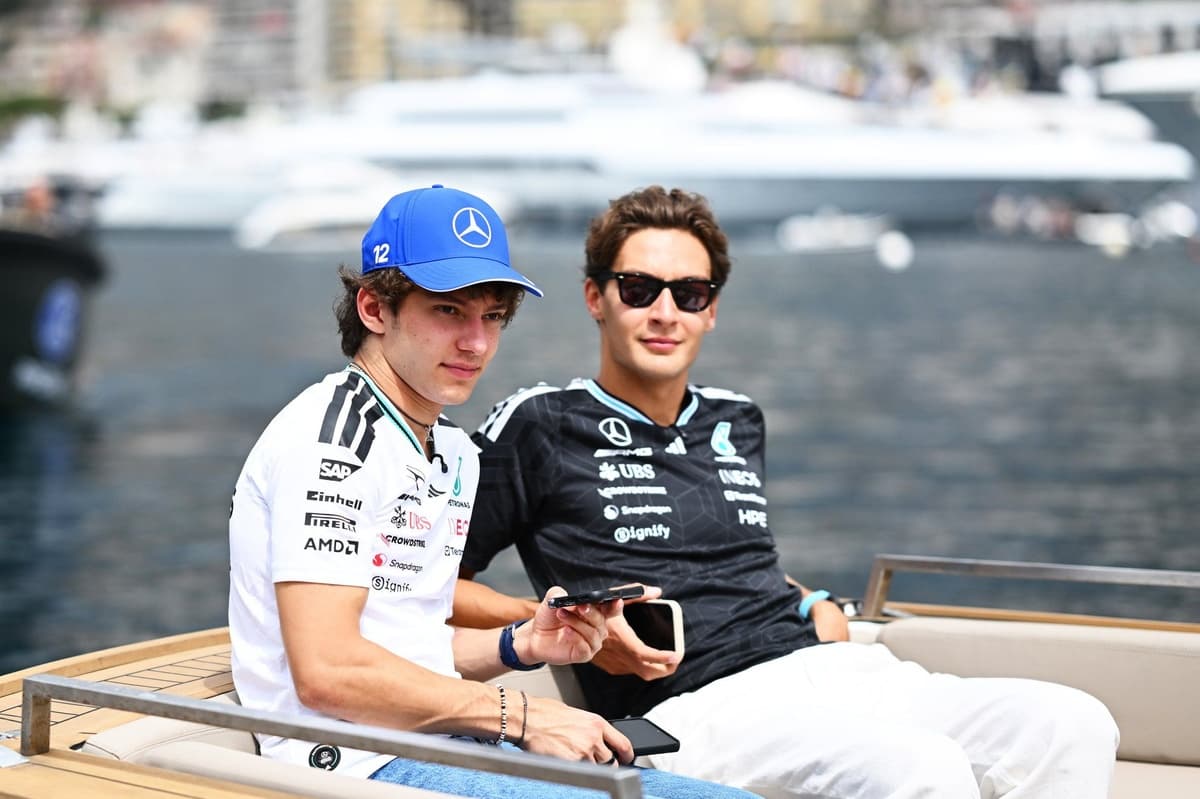
George Russell’s fifth qualifying defeat to Andrea Kimi Antonelli at the Monaco Grand Prix has exposed a persistent driving-style mismatch on low-energy circuits, while the 19-year-old Italian continues to handle every escalating challenge with remarkable composure.
George Russell arrived in Monaco already carrying the weight of a 43-point deficit — the consequence of a costly retirement in Canada — and left the principality with fresh concerns after being outqualified by teammate Andrea Kimi Antonelli for the fifth time this season. Antonelli secured pole position on the 3.3km street circuit while Russell could manage only sixth, four tenths off the pace.
The gap between the two Mercedes drivers is no longer attributable solely to misfortune. Russell enjoyed a lights-to-flag win in Melbourne to open the 2026 Formula 1 season, but a sequence of adverse events — unfavourable safety car timing, reliability failures in China, Japan, and Canada — steadily transferred momentum to Antonelli. What has since emerged, however, is a second and arguably more structural concern: a driving-style mismatch that surfaces specifically on low-energy circuits where tyre warm-up is a decisive factor.
The pattern first became visible at the Miami Autodrome, where Russell qualified four tenths behind Antonelli in both sprint and grand prix qualifying sessions. Russell initially attributed the deficit to Miami’s smooth asphalt surface, which he identified as a track that has historically not suited him. Yet the same dynamic reappeared in Montreal and Monte Carlo — circuits characterised by an abundance of low-speed corners and limited high-speed sections capable of generating meaningful lateral tyre load.
In Canada, Russell narrowly outqualified his teammate, though he acknowledged he was “nowhere until the last lap of Q3” in both sessions and described his eventual effort as a “special” lap wrested from difficult circumstances. Monaco offered no such reprieve. Antonelli, displaying what many observers regarded as his finest performance in Formula 1 to date, resisted a strong late challenge from four-time world champion Max Verstappen to take pole, while Russell struggled throughout to bring his tyres up to operating temperature.
“I don’t really know what’s going on to be honest,” Russell told reporters after qualifying. “It’s clearly something with my driving that’s not helping the car at the moment.”
Telemetry analysis from Monaco indicates that the largest portion of Russell’s four-tenth deficit accumulated through the second and third sectors, with the Nouvelle Chicane identified as a particularly problematic area. Antonelli, by contrast, appears to generate tyre heat naturally through a more aggressive steering input, placing the W17’s rubber into its optimal operating window without requiring significant mechanical adjustment. Russell’s smoother style, which proved an asset in the 2025 season’s car, appears to be working against him in the current specification.
“I think there’s clearly a difference in driving style between the two of us, which has been there last year as well,” Russell elaborated. “It played into my hands very well last year and it clearly is playing into his hands perfectly well this year, but it still doesn’t answer why I was so good at the start of the year and so poor now. So we need to look at why that is. It’s clear in the data. The difference is how we’re driving has such an impact on the tyres. He’s just getting the tyres in a nicer window than me. A nicer balance over the course of a lap and the pace is just coming easier for him. I don’t know why that is.”
Russell’s engineering team is now examining adjustments to his out-lap procedure and exploring set-up modifications that could mitigate the warm-up deficit on comparable circuits. The upcoming Spanish Grand Prix at Circuit de Barcelona-Catalunya, with its long, high-load corners, is expected to provide a clearer picture of whether the issue is circuit-specific or indicative of a deeper incompatibility between Russell’s driving inputs and the 2026 car’s tyre requirements.
Compounding the situation is the second worrying trend: Antonelli’s increasingly assured response to each new level of pressure. The 19-year-old, who is in only his second Formula 1 season, has forged a strong working relationship with experienced race engineer Peter Bonnington — the same engineer who worked closely with Lewis Hamilton during his dominant years at Mercedes. That continuity appears to be contributing to Antonelli’s growing confidence.
“This is one of the most intense, if not the most intense qualifying sessions of the year, and it takes a massive effort, also in practice, because you just keep trying to get close to the limit,” Antonelli said after climbing out of the Mercedes following his pole lap. “Then it’s about finding the last two tenths, it’s not easy because the walls start to come closer and it’s not easy to gain the confidence. But I have to be honest, I felt great this morning.”
For Russell, the challenge ahead is twofold: resolving a technical and stylistic issue that the team has yet to fully diagnose, while contending with a teammate who is showing no signs of the inexperience that might otherwise offer a competitive buffer.
Formula 1Formula 1 · Jun 29
 Formula 1
 · Jun 28
 Formula 1
 · Jun 28
 Formula 1
 · Jun 28