 Formula 1
Verstappen Laughed Out Loud in Simulator After Silverstone’s 2026 Energy Management Demands Became Clear
Formula 1 · Jun 29

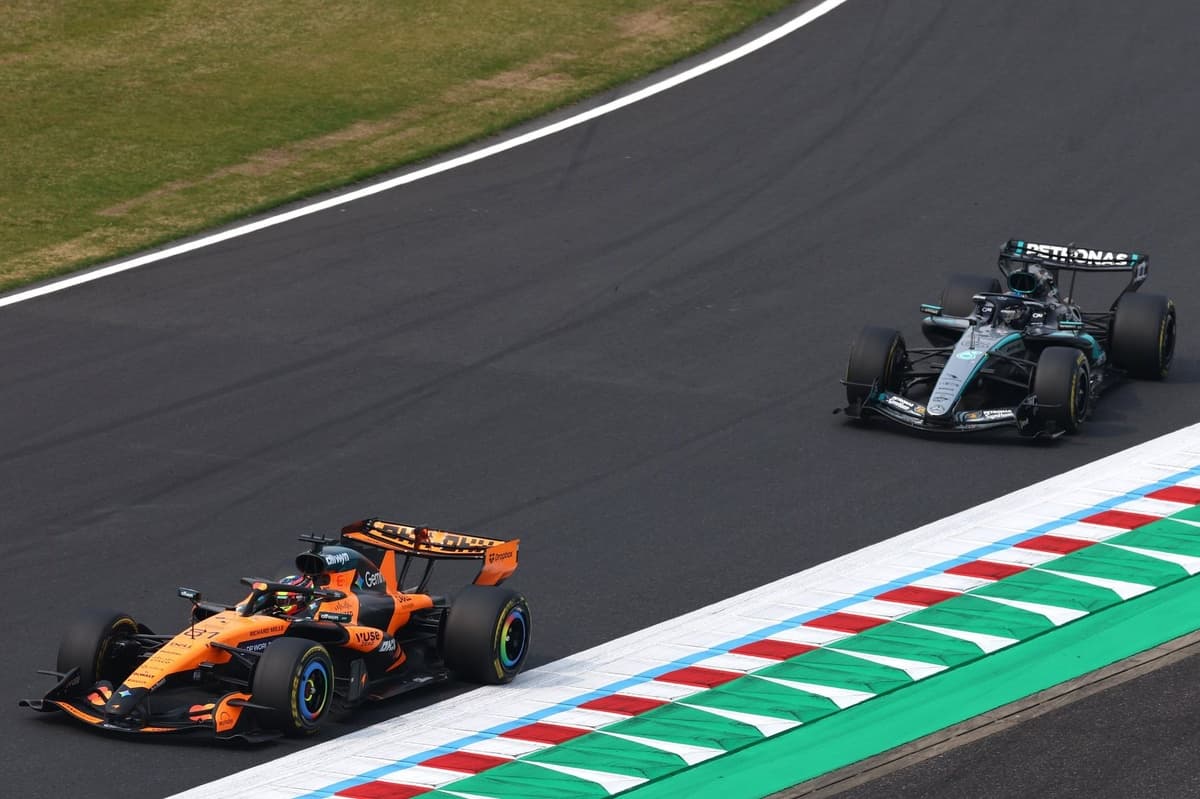
Despite sharing the same Mercedes power unit, McLaren and Mercedes have made contrasting gearbox ratio choices that are producing measurable performance differences across circuits in the opening rounds of the 2026 Formula 1 season.
The 2026 Formula 1 regulation overhaul has brought the gearbox back to the centre of car design discussions — a development that would have seemed unlikely just a few years ago, when the component was widely considered a candidate for standardisation across the grid as teams and the sport’s governing body sought to reduce costs.
Nowhere is this renewed relevance more apparent than in the contrast between McLaren and Mercedes. The two teams share the same power unit, yet they are exploiting it in markedly different ways — differences that are measurable not only through slow-speed sections but along the straights as well.
Unlike some customer teams, McLaren designs and manufactures its own gearbox entirely in-house, including all internal components. Critically, the Woking-based outfit has selected shorter gear ratios for the MCL40, a decision that carries both performance benefits and trade-offs depending on circuit characteristics.
“I think there are definitely pros and cons with the ratios,” McLaren team principal Andrea Stella said during the Canadian Grand Prix weekend. “We are on the shorter side compared to Mercedes. This may give you some advantages in acceleration, for instance, possibly it may give you advantages in a start.”
The practical consequences of that choice had begun to emerge in the season’s opening rounds, but five grands prix into the campaign the picture has sharpened considerably. McLaren has repeatedly demonstrated stronger race starts than Mercedes despite the shared power unit, indicating that Mercedes’ launch difficulties stem from more than one contributing factor.
Shorter gear ratios increase torque multiplication at the driven wheels, which is particularly advantageous in the earliest phase of acceleration — before the MGU-K begins contributing electrical power and the car depends entirely on the internal combustion engine. The benefit is contingent, however, on engineers accurately assessing available grip to prevent excessive wheelspin. By contrast, teams such as Mercedes and Red Bull have opted for relatively longer lower gears under the current regulations, a configuration that keeps engine revs elevated through slow corners and maximises battery recharging opportunity. Different ratio selections also place varying levels of stress on the engine, requiring careful calibration.
The consequences extend well beyond the start line. Across the first five races, a recurring pattern has emerged — one Stella himself has acknowledged — whereby the shorter the straight, the more competitive the MCL40 tends to be relative to its rivals.
Miami and Montreal provided contrasting test cases. In Miami, the FIA permitted up to 8 MJ of energy recovery in qualifying — the maximum allowed under current regulations — while in Canada the limit was reduced to 6 MJ per lap, demanding considerably more selective energy management from all teams.
In Miami, McLaren was able to stay competitive on the opening straight, but its pace began to fade as the straight lengthened. The situation was compounded by a specific strategic intervention: after encountering problems exiting Turn 16 in earlier sessions, McLaren instructed its drivers to cancel superclipping before braking for Turn 11. While this resolved the exit issue, it also altered the team’s battery management approach. By the time cars reached the final braking zone at the end of the long straight, the MCL40 was dealing simultaneously with its shorter eighth gear and a depleted electrical reserve — producing a top-speed deficit of more than 10 km/h relative to the Mercedes W17.
A comparable dynamic played out in Canada, despite the Circuit Gilles Villeneuve presenting a very different energy recovery profile. On the two shorter straights of Sector 2, where top speeds hovered around 290 km/h, McLaren matched Mercedes’ pace. On the longer run to the final chicane, however, Mercedes recovered its advantage.
Gearbox trace data reinforces the picture: McLaren regularly engages a gear higher than its rivals in several sections of the lap, selecting eighth gear where others remain in seventh. On circuits where superclipping carries significant weight, achieving higher end-of-straight speeds offers a compound benefit — improved lap time and greater energy recovery capacity.
During Friday’s sprint qualifying session in Canada, the top-speed gap on the long straight at times exceeded 10 km/h, prompting McLaren to revise its energy management approach for Saturday’s running.
“It may give you advantage in a straight dependent on the speed, but it may have some disadvantages,” Stella added. “For instance, when we have speeds in a long straight like from corner 10 to 13, then you may want to have slightly longer, for instance, eighth gear. So, it’s a bit of a mixed bag as to where you want to [use it].”
The broader context is also relevant. In the early part of the season, McLaren was still in the process of fully understanding how to extract maximum performance from the Mercedes power unit — knowledge the manufacturer itself naturally holds in greater depth. That learning curve, combined with the fundamental ratio differences, has shaped the competitive dynamic through the season’s opening phase and will likely continue to influence both teams’ approaches as the calendar moves to circuits with varying straight-line characteristics.
Formula 1Formula 1 · Jun 29
 Formula 1
 · Jun 28
 Formula 1
 · Jun 28
 Formula 1
 · Jun 28