 Football
Frank Onyeka Signs Permanent Coventry City Deal After Helping Club Win Championship Title and Promotion
Football · Jun 30

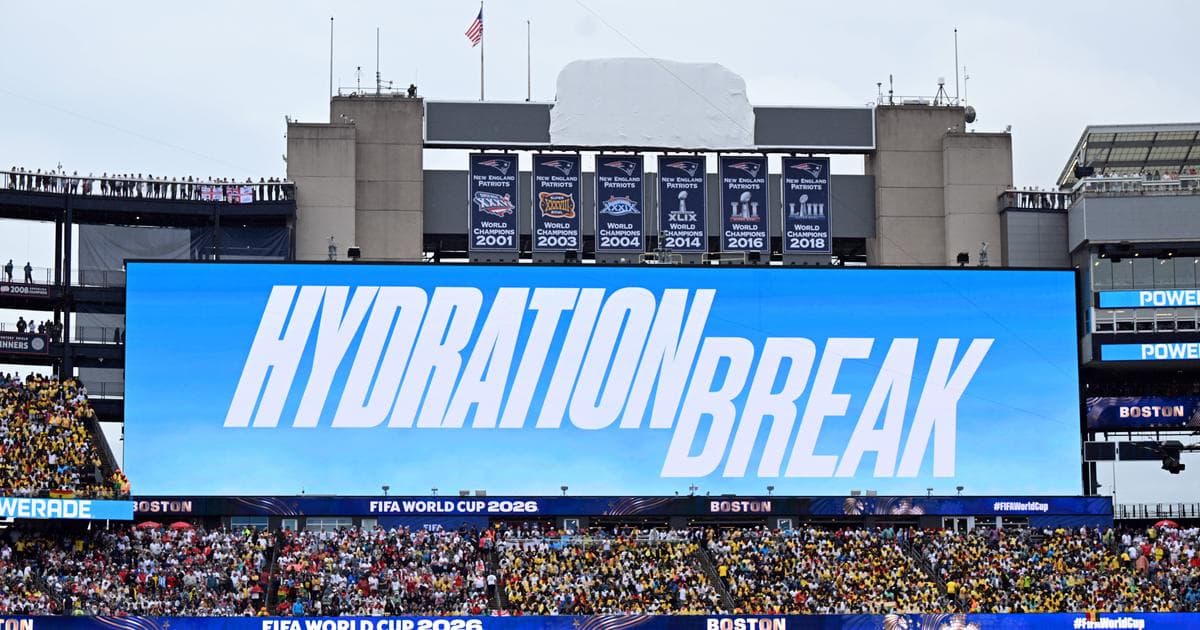
FIFA President Gianni Infantino has pushed back against accusations that the mandatory hydration breaks at the 2026 World Cup are commercially motivated, outlining three sporting justifications for the controversial rule.
FIFA President Gianni Infantino has directly addressed the mounting criticism surrounding the mandatory hydration breaks introduced at the 2026 FIFA World Cup, dismissing claims that the policy was engineered to generate additional commercial revenue for the governing body.
For the first time in World Cup history, three-minute hydration breaks have been built into every match at the expanded 48-team tournament, occurring at the 22nd and 67th minutes of each game. Any time lost during the stoppages is added to the end of the respective half as stoppage time. The protocol has drawn significant backlash from coaches, players, and supporters, with particular criticism directed at breaks being called inside climate-controlled venues such as Atlanta Stadium, where heat is not a factor.
A central grievance among critics is the observation that broadcasters immediately cut to full-screen commercial slots during the pauses. Television networks are estimated to generate between $250 million and $500 million in additional advertising revenue as a result. However, in an official statement cited by Pulse Sports, Infantino made clear that FIFA itself sees none of those gains.
“There is no additional revenue for FIFA, as all commercial agreements were signed well in advance,” Infantino stated. “So, this is not a financial issue for us. For us, it is purely a sporting matter. Broadcasters maybe, they make, they generate more. I don’t know, that’s great for them. But for us, we make zero additional revenues.”
Because FIFA’s global television rights contracts were finalised years before the hydration break regulation was introduced, the organisation has no financial stake in the mid-game commercial windows. Infantino was categorical on this point, describing it as a matter of sporting governance rather than commercial strategy.
The FIFA president also offered a less-discussed rationale for why breaks are applied universally across all venues, regardless of temperature or playing conditions. If stoppages were only triggered reactively during matches played in extreme heat, coaches in hotter stadiums would gain an unscheduled tactical timeout unavailable to their counterparts playing in cooler or enclosed environments — creating an uneven competitive advantage.
“What matters even more to us is ensuring that all teams, in every match, are playing under the same conditions,” Infantino said. “And it’s very difficult to accept that a coach might have the opportunity to influence a match by making adjustments simply because it’s hotter, while in another match, where the temperature is slightly lower, the same coach doesn’t have the same opportunity. We want to ensure equal conditions for everyone.”
Infantino further argued that the breaks have contributed to the high-intensity attacking play observed throughout the tournament, suggesting that a brief mid-half recovery period may be enabling players to sustain their output deep into matches.
“We’ve never seen 90 minutes in a tournament like this played in such an intensity,” he said. “Until the last seconds of the match, players attack, and so on. And maybe — maybe not — but maybe it’s also thanks to this little break that the players have, and after they can come back on the field and show what they can do.”
Despite Infantino’s defence, opposition from senior coaches has not subsided. England manager Thomas Tuchel stated that the rule “interrupts and changes the identity of the football match,” while Uruguay head coach Marcelo Bielsa argued that segmenting a continuous game undermines football’s defining characteristic as an unbroken contest.
FIFA has confirmed it will conduct a full review of data and performance metrics gathered during the tournament before deciding whether mandatory hydration breaks will be retained for future World Cup editions. The final is scheduled for July 2026, after which the governing body’s analysis is expected to begin.
FootballFootball · Jun 30
 Football
 · Jun 30
 Football
 · Jun 30
 Football
 · Jun 30