 Football
Frank Onyeka Signs Permanent Coventry City Deal After Helping Club Win Championship Title and Promotion
Football · Jun 30

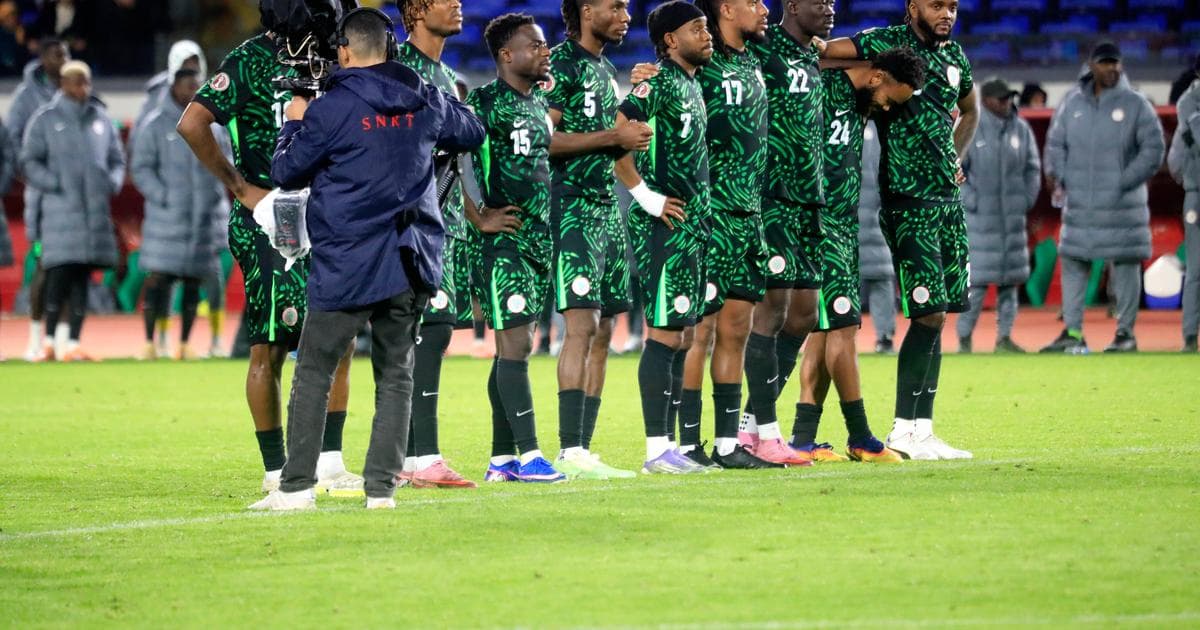
Former Green Eagles winger Adegoke Adelabu has called out the Nigerian federal government for failing to hold the NFF accountable following the Super Eagles’ back-to-back failures to qualify for the FIFA World Cup, describing the situation as a national embarrassment.
Nigeria’s absence from the 2026 FIFA World Cup — to be hosted across the United States, Canada, and Mexico — has reignited fierce debate about the state of football administration in the country. For the second consecutive tournament, the Super Eagles will not feature on the global stage, having also missed out on Qatar 2022. The back-to-back absences have drawn sharp criticism from former players, with ex-Green Eagles winger Adegoke Adelabu among the most vocal.
Speaking to The Guardian, Adelabu placed significant blame on the Nigerian federal government, arguing that its failure to intervene after the 2022 World Cup qualification failure directly enabled the current situation. “I am sure if our government had taken action after the NFF failed to qualify for Qatar 2022, this failure in 2026 would have been avoided,” he said. “Now, the NFF top officials feel no one can do them anything. It’s bad for our nation.”
Adelabu was unsparing in his assessment of the Nigeria Football Federation, suggesting its officials have faced no meaningful consequences for consistent underperformance. “It may look as if the NFF officials are getting away with their failures, but sooner or later nemesis will catch up with them,” he stated. “They will surely give account of their stewardship.”
The former winger also pointed to deeper structural problems within Nigerian football governance. “There is a lack of implementation of the principle of checks and balances, which has reduced the whole exercise of Nigerian football to futility,” Adelabu explained. “We have come to the point that actually reflects our lack of foresight and lack of professional competence to run an advanced football industry.”
Adelabu characterised the federation’s approach to progress as fundamentally flawed. “There is not much we can say, because we are still in the same place of trying to buy progress at whatever cost to remain relevant,” he added. His remarks point to a pattern of short-term decision-making that has, in his view, left Nigerian football stagnant.
The context makes the criticism particularly pointed. Africa has been allocated 10 slots for the 2026 World Cup — a significant increase from previous editions — making Nigeria’s failure to qualify even harder to justify. With more berths available than at any prior tournament, Adelabu described the dual absence as a “big embarrassment” for the country. “I think the government is in complete negligence of the issues of sport at this time,” he said.
Despite the World Cup disappointment, the Super Eagles did claim silverware in the international window, securing the Unity Cup trophy after defeating Jamaica in the final. While the title offers some consolation, it is unlikely to quiet the broader conversation around accountability at the NFF and the long-term direction of Nigerian football.
Nigeria last appeared at a FIFA World Cup at Russia 2018, where the Super Eagles were eliminated in the group stage. The team has since endured a turbulent period marked by coaching instability, administrative disputes, and inconsistent results across qualifying campaigns. With the 2026 tournament set to kick off in the coming weeks, attention will increasingly turn to what structural reforms, if any, will be implemented ahead of the 2030 World Cup cycle.
FootballFootball · Jun 30
 Football
 · Jun 30
 Football
 · Jun 30
 Football
 · Jun 30