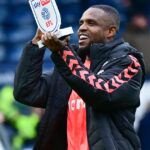
Nedum Onuoha, the 39-year-old former Manchester City and Queens Park Rangers defender, has publicly acknowledged that declining a Super Eagles call-up remains one of the most consequential regrets of his football career. Speaking on the Mixer podcast alongside Joleon Lescott and a co-host, Onuoha reflected candidly on a decision that ultimately meant he never represented any nation at senior level.
Born in Warri, Delta State, Onuoha was eligible to represent Nigeria through his parents’ heritage, though he had also represented England at youth level. The central issue, he explained, was the timing of Nigeria’s approach — which coincided with an Africa Cup of Nations tournament and a critical period at Manchester City under then-head coach Roberto Mancini.
“At the time, there was gonna be an AFCON coming up, and the manager was getting in contact with me, and he was saying he wanted me to come down to it,” Onuoha told the podcast. “I’m currently not playing at City here and I’m gonna go away for six weeks in January. I’m gonna come back and I’m gonna have nothing. I was like, ‘I can’t, I don’t think I can do that.'”
Onuoha was clear that his reluctance was not rooted in any disconnect from Nigerian identity. “For me personally, I see myself as two different people because I am Mancunian, I’ll say that, but I’m very much Nigerian; Nigeria’s home for me. If I’m in a room full of people from Nigeria, I feel like I know every single one of them. Something about the culture is like, ‘That’s my family; that’s my bloodline; that’s what it is,” he said.
His hesitation, rather, stemmed from the professional risk he perceived in leaving City for an extended tournament window. Advisors at the time suggested the tournament could serve as a platform, but Onuoha was unconvinced. “People were saying, ‘Oh, you do it, you put yourself in a shop window.’ It’s like, ‘Nah.’ And it was different back then as well. It’s not like you see now, where players can go away to an AFCON or something like that, and it’s a platform now. It wasn’t really.”
The situation was further complicated by public criticism from Nigerian football royalty. Super Eagles legend Jay-Jay Okocha had warned Onuoha as far back as 2010 that he would come to regret the snub. John Obi Mikel also weighed in at the time. Onuoha acknowledged the impact of those comments, though he took issue with the framing. “Someone like Jay-Jay Okocha with the influence that he has, and to be fair, John Obi Mikel said a little bit as well; they put me in this bracket of people who would rather beg to play for England than choose to play for their homeland in Nigeria. Once you’re painted with that brush, you’re done.”
Despite those assurances that an England call-up was feasible, it never materialised. Onuoha went on to leave Manchester City — initially on loan to Sunderland before completing a permanent move to Queens Park Rangers — and retired six years ago following a stint in Major League Soccer with Real Salt Lake.
“As I retired, I regret not playing international football, and if I’d have had a chance to do it for Nigeria, I know how much it would have meant for people like me,” Onuoha said. “Through my career, there’s lots of things which I look back on and I wish I would have done something differently, even though in the moment it made perfect sense to me.”
Onuoha’s case is not unique in Nigerian football history. Several dual-eligible players have faced similar crossroads, with some — like Victor Moses and Wilfried Zaha’s equivalent decisions in other nations — drawing significant public debate. The AFCON scheduling conflict he described remains a recurring tension between club and international commitments for African players based in top European leagues, a subject that FIFA and CAF continue to navigate. Nigeria are currently preparing for the 2025 Africa Cup of Nations in Morocco, scheduled for later this year, with the Super Eagles under renewed scrutiny following recent qualifying campaigns.